
- Adult ticket
- Free
- Youth ticket
- Free
- Child ticket
- Free
- Ticket notes
- Free, no booking.
- Opening hours
- 1 Apr-30 Sep 9:00-17:00; 1 Oct-31 Mar 9:00-12:30 and 13:30-17:00; visitor center admission ends 30 min before closing
- Season
- Year-round
- Explore Normandy Pass
- Partner Free site (no entry fee); listed as a partner for app content
- Nearest station
- Bayeux (taxis and tour buses) Trains from Paris Saint-Lazare
- By car
- N13, D517 to Saint-Laurent-sur-Mer, then D514; free parking
- Official site
- Official website
Prices checked October 28, 2026. Dollar and pound amounts use the exchange rate of October 28, 2026 and are approximate.
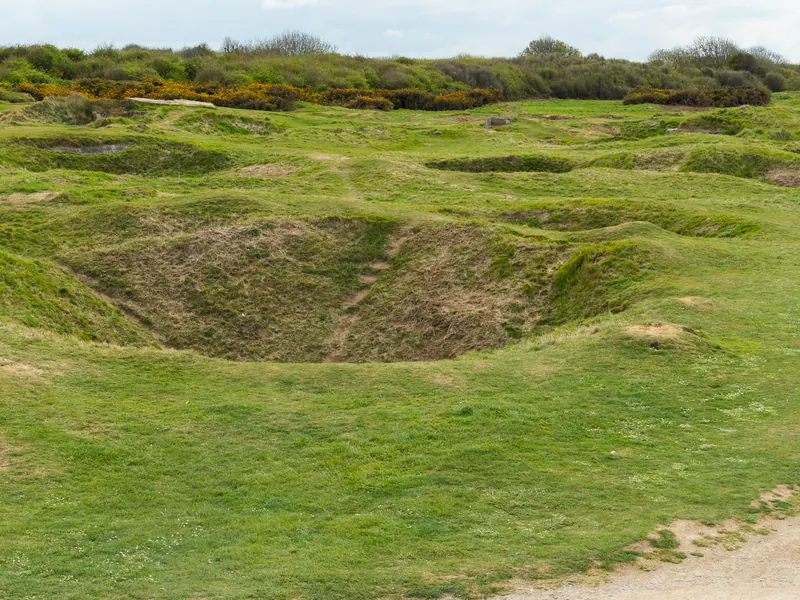

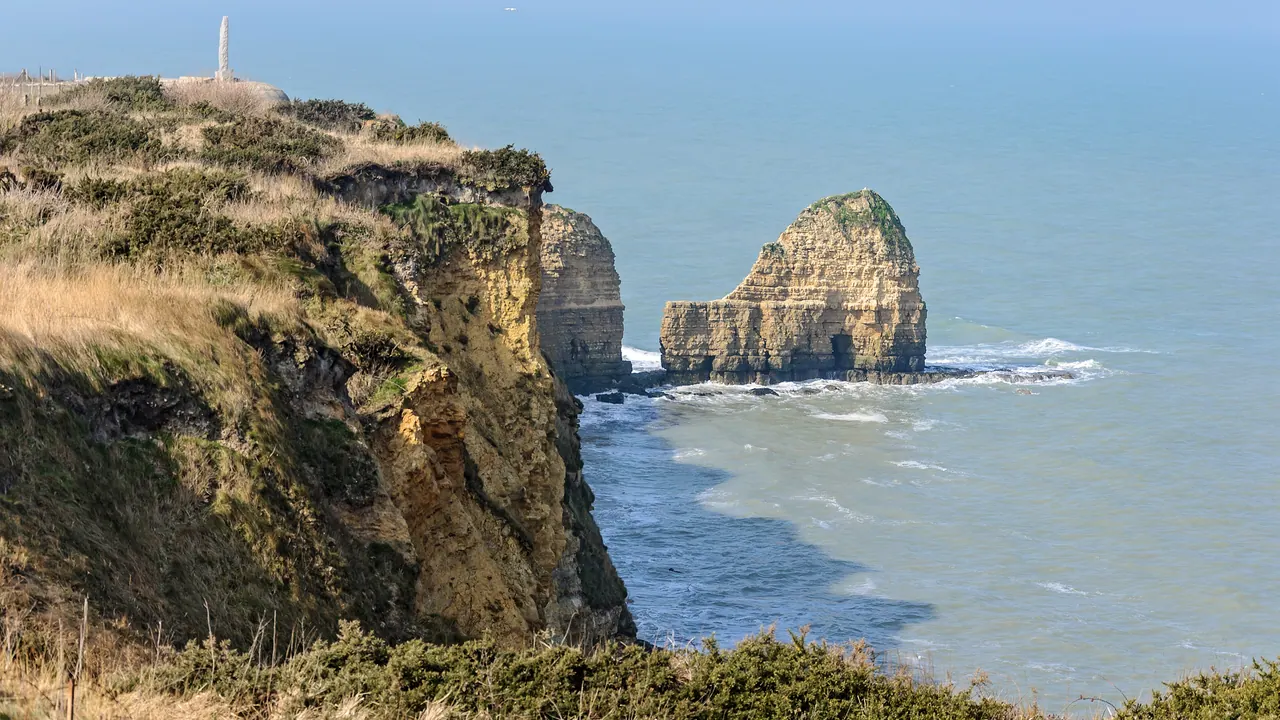
Pointe du Hoc is a cratered headland between Utah and Omaha beaches where US Army Rangers scaled sheer cliffs on D-Day to silence a German gun battery. The ground still carries the scars of the 1944 bombardment and is left largely as the Rangers found it. That makes it one of the most direct ways to grasp what June 6, 1944 looked like. Most visitors plan it as a stop on a day along the American sector, between Omaha Beach and the Normandy American Cemetery.
What happened here
The Allies feared that German 155mm guns on this point could fire on both Utah and Omaha beaches. The US 2nd Ranger Battalion, led by Lt. Col. James E. Rudder, was ordered to land at the foot of the cliffs at 6:30 a.m., climb the 100-foot rock face and put the guns out of action.
Naval guns, including the battleship USS Texas, opened fire on the point at 5:50 a.m. The Rangers came in late, at about 7:10 a.m., after losing two landing craft, and most of them were on top by about 7:40 a.m. When they reached the gun positions, they found the guns had been moved inland. They tracked them down and destroyed them by about 9:30 a.m., and they cut the coastal highway.
Then the Pointe du Hoc Rangers had to hold what they had taken. They fought for two days. When relief arrived from Omaha Beach on June 8, about 90 of them were still able to fight.
What you will see
Visitor center
Start at the visitor center, which sets out the story of the assault before you walk the ground. Information panels across the site add detail as you go. If you want something in hand, you can download the American Battle Monuments Commission (ABMC) brochures in English or French before you leave home. The free Pointe du Hoc smartphone app (iOS and Android) offers another way to follow the site.
The cratered headland
From the visitor center, a path leads out onto the point itself. The first thing most people notice is the ground: deep bomb craters, one after another, with grass growing over the churned earth. Nobody has smoothed this landscape out, so you see the force of the bombardment in the shape of the land rather than in photographs.
Stay on the marked paths. The ground is uneven and full of craters, and ABMC asks every visitor to keep to the routes laid out.
Casemates, shelters and the command post
As you move toward the cliffs, you pass the remains of the German defenses: concrete casemates that once held guns, shelters, and the firing command post. Some are broken open by the shelling. Walking among them gives you a sense of how closely packed the position was and how little cover the Rangers had once they came over the edge.
The Ranger Monument
At the cliff edge stands the monument the French put up to honor the 2nd Ranger Battalion. It is a granite pylon set on top of a German concrete bunker, with tablets in French and English. The site passed to ABMC for perpetual care on January 11, 1979, and the commission still looks after it today. From here you can look down the cliff face the Rangers climbed and along the coast toward the landing beaches.
Planning your visit
Pointe du Hoc is open year-round. For opening hours and any seasonal changes, see the Visit facts box above. Entry is free and there is no booking, so you can fit it in whenever it suits your route.
For what to expect through the year, see Normandy weather by month and the best time to visit Normandy. Around June 6 the whole coast gets much busier; the D-Day anniversary page explains what that means for your plans.
ABMC notes that the site is under construction for a cliff stabilization project and has not published dates for any closures. Check the official ABMC Pointe du Hoc page shortly before you go in case parts of the headland are fenced off.
On site you will find free parking, toilets, a baby-changing area and bicycle parking. The paths cross rough, cratered ground, so wear sturdy shoes, and keep in mind that the terrain may be hard going for anyone with limited mobility.
Pointe du Hoc is listed as a partner of the Explore Normandy Pass, the official pass of Normandie Tourisme, the regional tourism board. Entry here is free anyway; the pass’s free version adds extra content such as audio and video at partner sites. My Normandy Pass is an independent guide. It is not affiliated with Normandie Tourisme or the official Explore Normandy Pass. To total entry prices across the sites you plan to see, try our Normandy pass calculator.
Visiting Pointe du Hoc fits well into a full day on the beaches. Our one-day D-Day beaches itinerary and two days in Bayeux and on the beaches both show how to combine it with nearby sites.
Getting there
The address is 14450 Cricqueville-en-Bessin.
By car
From Paris, ABMC’s route is the A13 to Caen, then the N13 toward Bayeux and Cherbourg, the D517 to Saint-Laurent-sur-Mer, and the D514 toward Pointe du Hoc. At a roundabout about 6 miles west of Saint-Laurent, follow the signs to the car park. Note that the A13 Saint-Cloud tunnel near Paris is closed in the Paris-to-Normandy direction from November 16, 2026 to the end of August 2027, with signed diversions. Parking at the site is free.
By train
There is no station at the site. According to ABMC, the train from Paris Saint-Lazare to Bayeux takes about three hours. From Bayeux, you continue by taxi or tour bus. Our Normandy without a car itinerary and the getting to Normandy from Paris guide cover the options in more detail.
By tour
Tour buses run from Bayeux, and the Mémorial de Caen’s guided minivan tour of the American sector includes Pointe du Hoc. If you are coming from Paris for a single day, see the D-Day beaches day trip from Paris.
Nearby
Driving times below are estimates without traffic.
Omaha Beach is about 16 minutes away (11 km), and it is where the relief force came from on June 8, so the two sites tell one connected story.
The Normandy American Cemetery is about 17 minutes away (13 km) and makes a natural next stop after the Rangers’ battlefield. ABMC expects compulsory pre-registration for all visitors to the cemetery from summer 2027, so check its requirements before you go.
Bayeux is about 31 minutes away (30 km), with the train station, taxis and tour buses, which makes it the easiest base for visiting Pointe du Hoc without a car.
The Utah Beach D-Day Museum is about 41 minutes away (40 km) and covers the other beach the battery’s guns threatened.
Frequently asked questions
Is Pointe du Hoc free to visit?
Yes. Entry is free and you do not need to book ahead. Parking at the site is also free.
How long do you need at Pointe du Hoc?
The official guidance does not set a visit length. Leave enough time for the visitor center, the marked paths through the craters and bunkers, and the monument at the cliff edge. The Visit facts box above has the current opening hours.
Who were the Pointe du Hoc Rangers?
They were men of the US 2nd Ranger Battalion under Lt. Col. James E. Rudder. On D-Day they climbed the 100-foot cliffs to put German 155mm guns out of action, and they held the headland until relief arrived from Omaha Beach on June 8.
Can you visit Pointe du Hoc without a car?
Yes. Take the train from Paris Saint-Lazare to Bayeux, then a taxi or a tour bus from Bayeux to the site.
Is there anything to help me understand the site?
There is a visitor center with information panels on the grounds. You can also download ABMC brochures in English and French, and there is a free Pointe du Hoc app for iOS and Android.
Sources
- About Pointe du Hoc Ranger Monument (ABMC)checked October 28, 2026
- History of Pointe du Hoc Ranger Monument - American Battle Monuments Commission (ABMC) : American Battle Monuments Commichecked October 28, 2026
- Plan your visit to Pointe du Hoc Ranger Monument - American Battle Monuments Commission (ABMC) : American Battle Monumenchecked October 28, 2026
- Pointe du Hoc site - Normandy Tourism, Francechecked October 28, 2026
- The Explore Normandy Pass - Normandy Tourism, Francechecked October 28, 2026
- OSRM driving-time estimates (OpenStreetMap data, no traffic)checked October 28, 2026