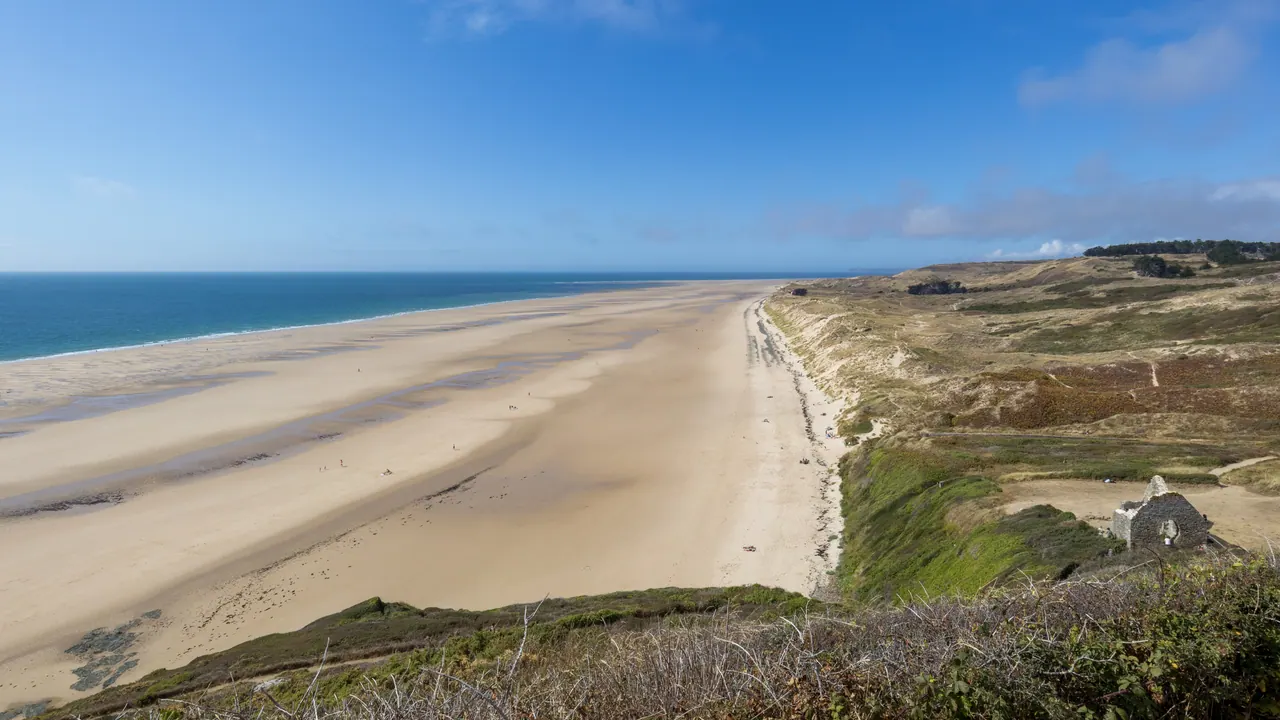
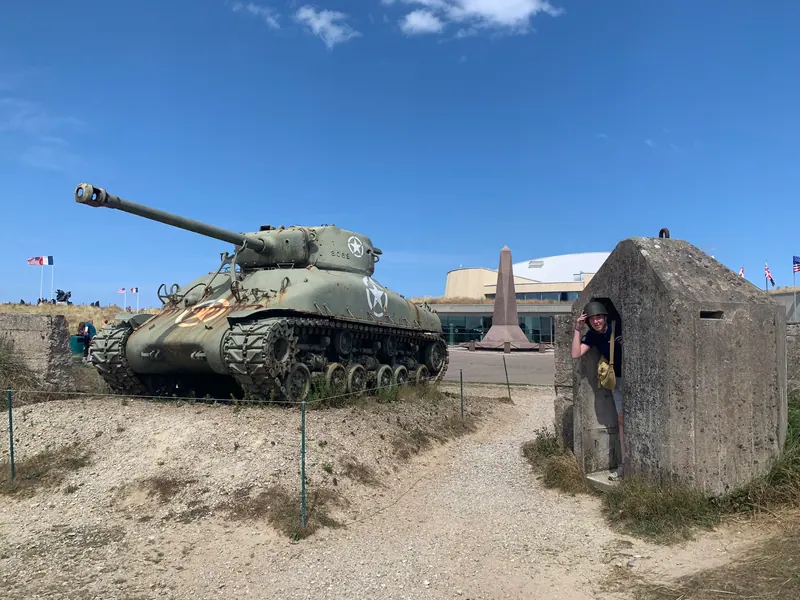
The beaches in Normandy fall into two groups: the five D-Day landing beaches of June 6, 1944, and the seaside resorts that drew bathers long before the war. This guide runs roughly west to east along the D-Day coast, then covers the resorts of the Côte Fleurie, the chalk cliffs of the Alabaster Coast and finally Granville, out to the west. For each beach you get what is there, what to watch for, and how to reach it with or without a car.
The D-Day beaches
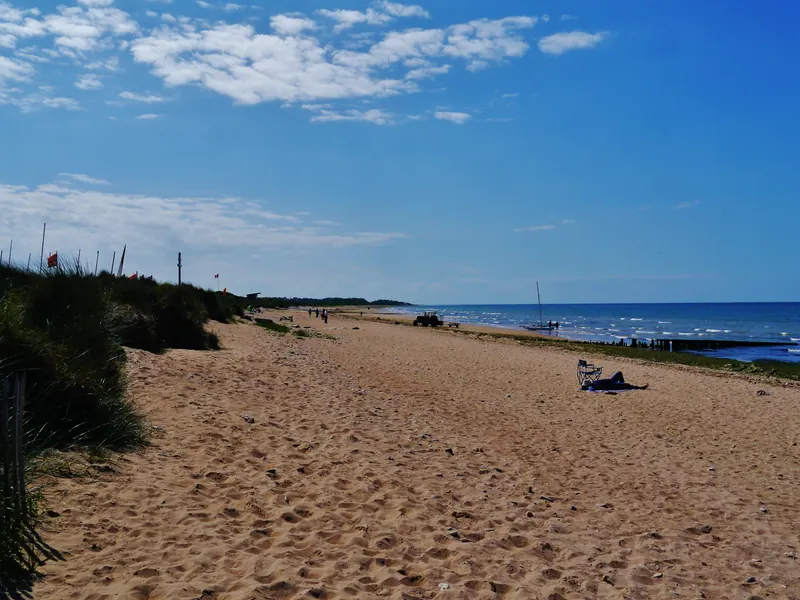
The five D-Day beaches run from west to east: Utah in the Manche department, then Omaha, Gold, Juno and Sword in Calvados. You can visit them all year. Early June is the busiest time because of the anniversary events (see D-Day Anniversary: June 6 in Normandy). Plan any walk on the sand around the tides.
You don’t need a car for every site. Several key places can be reached from the stations at Caen, Bayeux or Carentan. The D-Day beaches map shows how the sectors line up, and the D-Day and the Battle of Normandy guide gives the wider story.
Utah Beach
Utah is the westernmost landing beach, running from Sainte-Marie-du-Mont to Quinéville in the American sector. It was added to the invasion plan in December 1943 to help capture the port of Cherbourg sooner. On the day itself, troops of the US 4th Infantry Division came ashore about 2 km south of the planned point, where the defenses turned out to be weaker.
The Utah Beach D-Day Museum stands on the landing site at La Madeleine. It tells the story in 10 sequences and shows an original B-26 bomber in its own hall. The museum suggests 1.5 to 2 hours. The nearest station is Carentan, 17 km away, and the Vélomaritime cycle route runs from Carentan to the museum.
Omaha Beach
Omaha Beach stretches from Vierville-sur-Mer to Colleville-sur-Mer. It is a 6-7 km curve of beach between cliffs, reached through narrow valleys that German forces guarded with 14 strongpoints. By the evening of D-Day the American beachhead was no more than 2 km deep.
The Normandy American Cemetery overlooks the beach at Colleville-sur-Mer. The American Battle Monuments Commission expects every visitor to pre-register from summer 2027, so check before you go. Two private museums, the Omaha Beach Memorial Museum in Saint-Laurent-sur-Mer and the Overlord Museum near the cemetery, add exhibits and vehicles. There is no railway station on this part of the coast; taxis and tour buses run from Bayeux station.
Gold Beach and Arromanches
Gold runs from Asnelles to Ver-sur-Mer. Its center is Arromanches-les-Bains, a seaside resort since the 1870s, where the Allies built a prefabricated harbor known as Port Winston. Planned to last about three months, it was used for about five, and concrete remains still sit offshore.
The Arromanches D-Day Museum is on the seafront and covers both the British and the American artificial harbors. The museum gives an average visit of 1h30; Normandy Tourism gives 1h15. On the cliff above town, Arromanches 360 shows a 20-minute archive film on nine screens.
Juno Beach
Juno was the Canadian sector, from Bernières-sur-Mer to Courseulles-sur-Mer, between the British beaches of Gold and Sword. Rough seas and reefs delayed the first wave, yet by nightfall the beachhead reached 12 km inland.
The Juno Beach Centre in Courseulles-sur-Mer was opened in 2003 by Canadian veterans and volunteers. From April to October you can join a 45-minute guided tour of the German bunkers in the park beside it. Without a car, take bus 101 from Caen or bus 121 from Bayeux, then walk 650 m (about 8 minutes).
Sword Beach
Sword is the easternmost of the five, in front of Hermanville-sur-Mer and Colleville-Montgomery.
The Côte Fleurie resorts
East of the landing beaches, the coast turns into classic resort country, with wide sand and boardwalks.
Deauville
Deauville beach has wide sand, rows of parasols, beach huts and a wooden boardwalk. The resort was created in the 1860s and hosts the American Film Festival every September. The seafront gets very busy on fine days, and Normandy Tourism suggests walking it early in the morning.
Trains run from Paris Saint-Lazare to Trouville-Deauville station, with the fastest taking 2h15 according to SNCF Connect. See Deauville and Trouville for more on both towns.
Trouville-sur-Mer
Trouville sits next to Deauville and shares its station. It was one of France’s first seaside resorts, and its boardwalk dates from 1867, making it the first on the Normandy coast. There is also a fish market on the quays. The Deauville and Trouville page covers both towns.
Cabourg and the coast from Merville to Houlgate
Cabourg has drawn sea bathers since 1855. Its Marcel Proust promenade runs 3.6 km and is described by the tourist board as the longest pedestrian promenade in Europe. Proust stayed regularly at the Grand Hôtel between 1907 and 1914.
The wider stretch between the Orne and Touques estuaries, covering Merville-Franceville-Plage, Varaville, Cabourg and Houlgate, has water-sports schools offering kitesurfing and other sports, plus beach clubs for children. Its dunes and estuaries are used by migratory birds. Cabourg is about 30 minutes from Caen and from Deauville by car. By train from Paris Saint-Lazare, you change once at Trouville-Deauville.
The Alabaster Coast
North of the Seine, the sand gives way to pebbles and white chalk cliffs.
Étretat
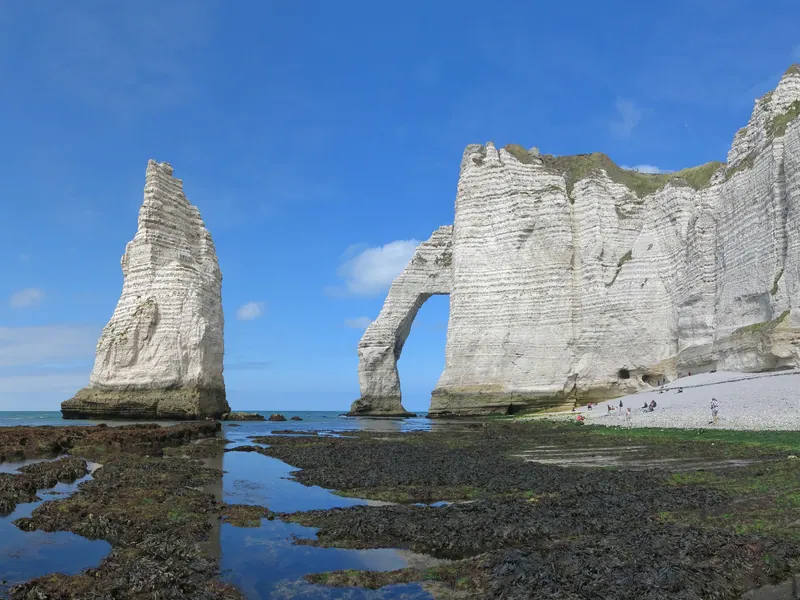
Étretat beach is a shingle beach of small round pebbles set between chalk cliffs and arches. Facing the sea, the Porte d’Aval arch is on your left beside a 51-meter rock needle, with the larger Manneporte beyond it, and the Falaise d’Amont is on your right. The cliffs rise to nearly 90 meters, and the GR21 footpath along the top is free to walk.
Follow the local rules: walking at the foot of the cliffs is forbidden, you must keep at least 5 meters back from the edge on the plateaus, and you may not take pebbles. The beach is busiest between around 11 a.m. and 4 p.m. and in July and August, so come early, late or out of season. See Étretat and Étretat Cliffs and Gardens for the village and the clifftop gardens.
Parking in the village is hard to find, but there is free parking at the village entrance with a footpath in. Without a car, SNCF sells combined train and coach tickets from Paris from April to early November; out of season, take the train to Le Havre or Fécamp and then the NOMAD coach.
From Le Havre to Étretat
Within 30 km between Le Havre and Étretat lie five beaches. Le Havre’s own beach is more than 2 km long and reachable by tram. Next come Sainte-Adresse and Saint-Jouin-Bruneval, then Tilleul, which you reach on foot with a walk of about 1.5 km, and finally Étretat. If you arrive by ship, the Le Havre Cruise Port Day itinerary shows how to fit the coast into a port call.
Granville and the Chausey Islands
At the western edge of Normandy, Granville offers a different kind of seaside trip, with a port town as the base and islands offshore.
Granville
Granville is a walled port town with a seawater pool and the Christian Dior Museum, set in the designer’s childhood home. Direct trains run from Paris-Montparnasse, Caen and Rennes, so it works without a car.
The Chausey Islands
The Chausey Islands lie about 15 km offshore and are reached by ferry or sailing boat. The tide changes them dramatically: they form 52 islets at high tide and 365 at low tide.
Planning your route
You can split the Normandy beaches into a history trip and a resort trip. For the D-Day beaches, Bayeux makes a central base. Use One Day on the D-Day Beaches if time is short, or Two Days in Bayeux and on the D-Day Beaches to cover Utah through Juno at a calmer pace.
Driving times give a sense of scale. These are road estimates without traffic. Omaha Beach to Pointe du Hoc is about 15 minutes (11 km), and Omaha to Bayeux about 24 minutes (22 km). Arromanches to the Juno Beach Centre is about 17 minutes (13 km). On the Alabaster Coast, Étretat to Honfleur is about 48 minutes (46 km), and Étretat to Deauville-Trouville about 64 minutes (63 km).
To combine beaches with Mont-Saint-Michel, Giverny or Rouen, see Three Days in Normandy or Five Days in Normandy. Without a car, Normandy Without a Car builds a trip around the train lines to Bayeux, Caen, Trouville-Deauville and Granville. From Paris, the D-Day Beaches Day Trip from Paris and Honfleur Day Trip from Paris cover one-day options.
If you drive from Paris, note that the A13 Saint-Cloud tunnel is closed in the Paris-to-Normandy direction from November 16, 2026 to the end of August 2027, with signed diversions. Getting to Normandy from Paris has the routes. For timing, see Best Time to Visit Normandy and Normandy Weather by Month.
Sites in this guide
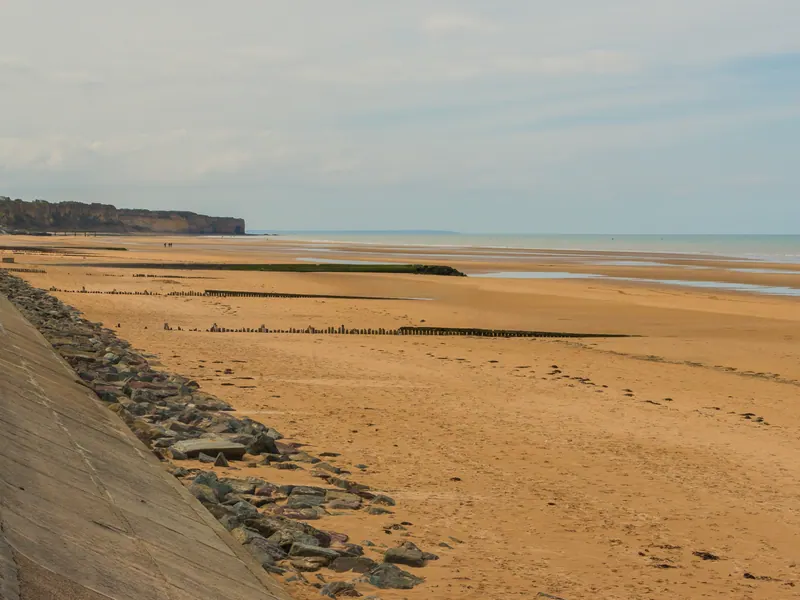
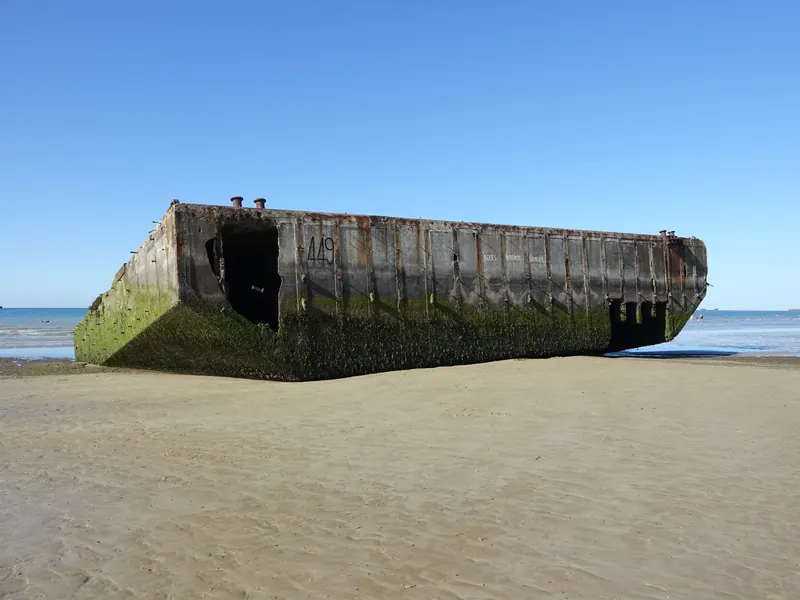

Frequently asked questions
Which beaches were the D-Day landing beaches?
There were five, running west to east: Utah, Omaha, Gold, Juno and Sword. Utah and Omaha were in the American sector, Juno was the Canadian sector, and Gold and Sword were the British beaches on either side of it.
Can you visit the D-Day beaches without a car?
Yes, for several key sites. Trains reach Caen, Bayeux and Carentan, and buses 101 from Caen and 121 from Bayeux stop near the Juno Beach Centre. Omaha has no station nearby, so taxis and tour buses from Bayeux station are the usual way there.
When are the D-Day beaches busiest?
Early June is the busiest time because of the anniversary events. You can visit the beaches all year, and spring, autumn and winter are quieter. Check the tides before you plan a walk on the sand.
Can you walk along the bottom of the cliffs at Étretat beach?
No. A municipal by-law forbids walking at the foot of the cliffs because rockfalls happen regularly. You also may not take pebbles from the beach.
How do you get to Deauville beach from Paris by train?
Trains run from Paris Saint-Lazare to Trouville-Deauville station, which serves both towns. SNCF Connect lists the fastest journey at 2h15.
Which Normandy beaches suit families with children?
The coast from Merville-Franceville-Plage through Varaville and Cabourg to Houlgate has beach clubs for children and water-sports schools. Deauville has a wide sandy beach and Trouville a sandy beach, each with a boardwalk.
Sources
- Utah Beach - Normandy Tourism, Francechecked October 28, 2026
- Sword Beach, D-Day Landing Beaches – Normandy Tourismchecked October 28, 2026
- D-Day Landing Beaches - Normandy Tourism, Francechecked October 28, 2026
- Omaha Beach, D-Day Landing Beaches – Normandy Tourismchecked October 28, 2026
- Gold Beach Artificial Harbour of Arromanches - Normandy Tourismchecked October 28, 2026
- Juno Beach, D-Day Landing Beaches – Normandy Tourismchecked October 28, 2026
- Map of the D-Day Landing Beaches- Normandy Tourism, Francechecked October 28, 2026
- Visit Deauville - Beach, Festival - Normandy Tourism, Francechecked October 28, 2026
- Paris to Deauville train: 8 trains per day - SNCF Connectchecked October 28, 2026
- Visit Trouville, beaches, villas - Normandy Tourism, Francechecked October 28, 2026
- Cabourg: visit the quintessential family seaside resortchecked October 28, 2026
- The best of Cabourg - Normandy Tourism, Francechecked October 28, 2026
- The most beautiful beaches in Normandychecked October 28, 2026
- Top 5 beaches - Le Havre Etretat Normandie Tourismechecked October 28, 2026
- Visit Etretat – cliffs, beach, walks - Normandy Tourism, Francechecked October 28, 2026
- The cliffs of Etretat - Le Havre Etretat Normandie Tourismechecked October 28, 2026
- Visit Granville, Bay of the Mont St Michel, Dior, islands - Normandy Tourism, Francechecked October 28, 2026
- Utah Beach | D-Day Museumchecked October 28, 2026