
Tool
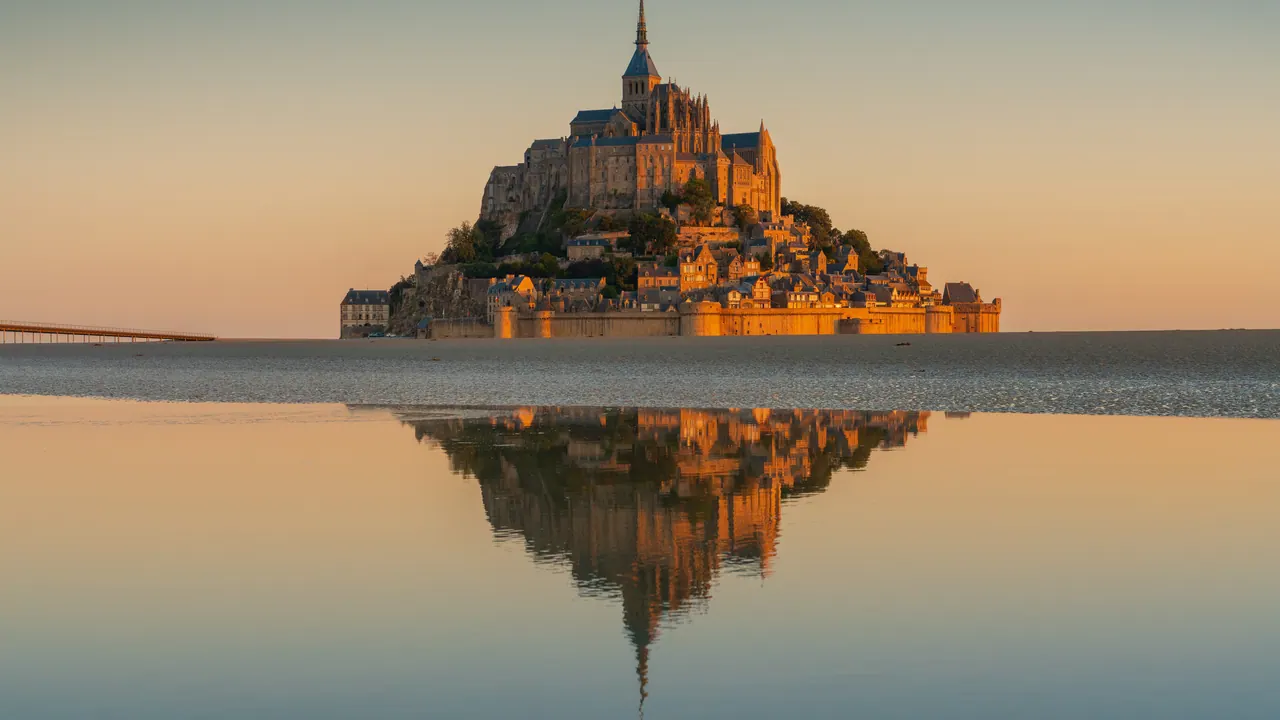
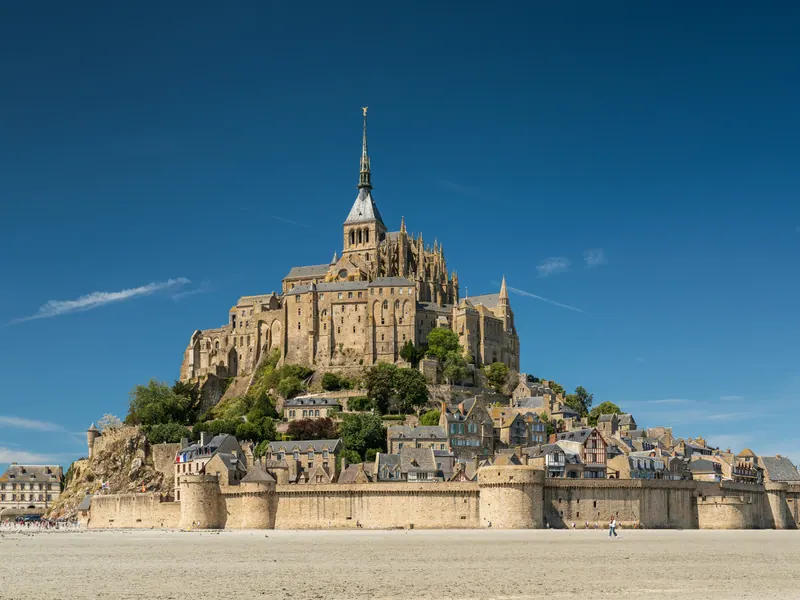
Mont-Saint-Michel is a rocky tidal island in the bay where Normandy meets Brittany. A walled village climbs the rock to a Benedictine abbey at the top. Visiting Mont-Saint-Michel takes at least half a day. You park on the mainland, ride a free shuttle or walk across a footbridge, and climb the village street to the abbey. The village itself has no gate and no ticket.
This guide covers, in order, the background, what to see, how long to allow, how to get there with or without a car, and how the tides and crowds should shape your timing.
The Mont in brief
In 708, Bishop Aubert of Avranches founded a sanctuary to the Archangel Michael on the rock. Benedictine monks settled there in 966, and work on the Romanesque abbey church began in 1023. During the Hundred Years’ War, the fortified Mont held out through a siege of almost 30 years, and the English never took it.
After the Revolution, the abbey served as a prison from 1793 until 1863. It was classified as a historic monument in 1874. A road causeway built in 1879 was replaced between 2006 and 2015 by a walkway bridge. At the same time the car parks moved to the mainland, and a dam on the Couesnon river now helps push sediment back out to sea.
The Mont and its bay joined the UNESCO World Heritage List in 1979. About 3 million people visit each year, and Normandy Tourism calls it the second most visited monument in France. The abbey is still a place of worship with a monastic community.
What to see
The village and ramparts
The village is a real commune, with a town hall, a parish church and a cemetery, and it stays open day and night all year. You enter the Grande Rue through three gates in a row. Along the way, look for the parish church of Saint-Pierre and the Gabriel Tower.
Then climb onto the ramparts, where a public walkway links seven towers. The village also has four private museums: a maritime museum, the Archéoscope, the Logis Tiphaine and a historical museum. You buy their tickets on site only.
The abbey
The abbey church stands 80 meters above sea level, with a Romanesque nave and a Gothic choir. The spire, topped by a statue of Saint Michael, rises to 160 meters above sea level.
Your visit also takes in these spaces:
- the cloister, with its 137 staggered columns
- the refectory
- the crypts
- the monks’ walkway
- the west terrace, which looks out over the bay
Some outdoor areas may close in bad weather. Only the abbey and parking cost money. For abbey prices, free-entry rules and hours, see the Mont-Saint-Michel Abbey page or the abbey’s official site.
How long to stay
Normandy Tourism suggests at least half a day for the village, ramparts and abbey. The abbey’s own site puts the abbey visit at 45 minutes to 1 hour 30. The public body that runs the site advises 1 hour 30 to 2 hours for the whole site.
Allow time for the approach as well. The abbey says that walking from the car parks to its entrance takes about 45 minutes to 1 hour, depending on crowds.
The climb and accessibility
The tourist office counts about 350 steps in all: about 200 in the Grande Rue and 150 inside the abbey. Entering by the Fanils entrance halves the climb. The public body notes slopes of up to 20% on the village street.
Access is only partial. The abbey is not wheelchair accessible and is very difficult with a pushchair, though folded pushchairs are allowed. These services help:
- Car park P2 is reserved for disabled visitors, at normal rates.
- The shuttles have ramps and wheelchair spaces.
- The visitor center lends wheelchairs free of charge.
Bags and pets
The abbey refuses suitcases and bags larger than cabin size, and it checks bags at a security gate. Use the lockers at the visitor center before you set off.
Pets are not allowed in the abbey, even if carried. Assistance dogs are allowed. On the shuttle, dogs must travel in a bag or basket, with guide and assistance dogs excepted.
How to get to Mont-Saint-Michel
By car: Mont-Saint-Michel parking
Cars park on the mainland, about 2.5 km from the rock. The parking fee covers the free Le Passeur shuttle and the visitor center services. The first 30 minutes are free all year.
Rates change with the season and how long you stay. Booking online saves a little. In mid and high season, though, the discount only applies if you arrive before around 10 a.m. or after around 3 p.m. From September to June, parking is free for part of the evening and night, so check the official site for the exact window. Bicycles park free, and hotel guests on the Mont use car park P3 with a code from their hotel.
Le Passeur runs from the shuttle square near the visitor center to a stop 350 m from the ramparts. The ride takes about 12 minutes, and you wait 12 minutes at most. Outside its service hours, you can request a shuttle on +33 (0)2 14 13 20 15. If you prefer to walk, the footbridge is 2.2 km long, and the walk from the shuttle square takes about 45 minutes.
If you drive from Paris, the A13 Saint-Cloud tunnel is closed in the Paris-to-Normandy direction from November 16, 2026 to the end of August 2027, with signed diversions. See Getting to Normandy from Paris for your options.
You can pair the Mont with the D-Day sites. OpenStreetMap routing gives these estimates, which do not account for traffic:
- Caen Memorial: about 116 minutes (130 km)
- Bayeux: about 126 minutes (129 km)
- Airborne Museum, Sainte-Mère-Église: about 129 minutes (142 km)
The Five Days in Normandy itinerary shows one way to fit them together.
Without a car
The nearest station is Pontorson, 9 km away. Bus line 2 runs daily from the station to the Mont in about 27 minutes, with 4 stops.
From Paris-Montparnasse, SNCF Connect lists 2 trains a day to Pontorson, the fastest taking 2 hours 57 minutes. The other route is the TGV to Rennes, then the Keolis Armor coach. In 2025, a direct train-and-coach service ran from Paris-Montparnasse daily through spring and summer and at weekends all year. Check SNCF for its current season. A Paris–Mont-Saint-Michel train ticket used within 5 days also qualifies you for a reduced abbey ticket.
For a full plan, see the Mont-Saint-Michel Day Trip from Paris and Normandy Without a Car.
Mont-Saint-Michel tides
The bay has the highest tides in continental Europe, with a range of up to 15 meters. At low tide, the sea pulls back about 15 km. The strongest tides arrive 36 to 48 hours after full and new moons. The sea only reaches the Mont during spring tides, about once a fortnight. Wind and air pressure can shift both the timing and the height of a tide.
When the Mont becomes an island
The sources give different answers on when this happens:
- Normandy Tourism says that when the coefficient exceeds 110, the Mont becomes an island for a few hours and access is cut off.
- The tourist office says it happens about 20 days a year during spring tides, for about an hour in the morning and evening.
- The public body works from water height at Saint-Malo. The forecourt floods from 12.70-12.80 m, and there is an island risk from 12.80 m. Above 13 m, the Mont is cut off and traffic is banned, which happens 0 to 12 days a year.
The public body’s 2026 booklet flagged only two island-risk tides: August 14 (21:28, coefficient 102) and September 12 (21:02, coefficient 101). It showed no risk in November or December 2026. As of October 28, 2026, no official island-risk calendar for 2027 had been published.
When water covers the forecourt between the footbridge and the village entrance, you do not need a boat. The tourist office says to wait about an hour, and the public body says to expect 1 to 1.5 hours before you can return to the footbridge.
Watching the tide come in
Arrive 1-2 hours before high tide to see the tidal bore and get onto the Mont before the water surrounds it. From the Mont itself, the bore is best seen about 2 hours before high tide. From other points around the bay, the best time is 30 minutes to 1 hour 30 before.
The tourist office’s tide tables use SHOM predictions for Saint-Malo, so add about 5 minutes for the bay. These are the strongest upcoming tides in its table:
- January 24, 2027: coefficient 107 (20:52)
- February 22, 2027: coefficient 110 (08:05 and 20:31)
- March 23, 2027: coefficient 106 (07:41 and 20:03)
The Mont-Saint-Michel tide calendar lists the biggest tides month by month.
Staying safe in the bay
Never go into the bay alone, even close to the Mont. Cross the sand only with a professional bay guide; the tourist office lists guided crossings, which run all year.
Once you are out on the sand, follow these rules:
- The water can start rising suddenly two hours before high tide, so head back to land well before high water.
- Do not cross channels or flooded areas.
- Watch for quicksand, which is real and dangerous.
- Stay off the bay in fog or storms.
- Do not fly drones, which are banned over the bay.
- Keep at least 300 m away from wildlife.
In an emergency, call 112.
When to go and where to stay
The public body reports twice as many visitors in summer as in winter. Normandy Tourism advises weekdays outside school holidays in autumn or winter, either early in the morning around 8 a.m. or after around 5 p.m. It also warns that high-tide days are always crowded. For the wider seasonal picture, see Best Time to Visit Normandy.
Staying overnight gives you the Mont outside day-trip hours. There are seven hotels inside the walls, plus a pilgrims’ house, the Maison du Pèlerin. The tourist office notes that hotels in the village and around the Mont have views of it. If you sleep on the rock during a spring-tide period, you can be there in the morning or evening when the sea surrounds it.
Sites in this guide
Frequently asked questions
Do you need a ticket to enter Mont-Saint-Michel?
No. The village has no gate or ticket and is open day and night all year. Only parking and the abbey are charged. See the abbey's attraction page or the official site for current prices.
How long do you need at Mont-Saint-Michel?
Normandy Tourism suggests at least half a day for the village, ramparts and abbey. The abbey alone takes 45 minutes to 1 hour 30, and getting from the car parks to the abbey entrance takes about 45 minutes to 1 hour depending on crowds.
Can you get to Mont-Saint-Michel without a car?
Yes. Take the train to Pontorson, 9 km away, then bus line 2, which runs daily and takes about 27 minutes. You can also take the TGV from Paris-Montparnasse to Rennes and continue on the Keolis Armor coach.
Is the Mont cut off at high tide?
Only during the biggest spring tides, and the sources disagree on how often this happens. When water covers the forecourt you do not need a boat. You wait about an hour, and the site's public body says to allow 1 to 1.5 hours before you can return to the footbridge.
Can you walk across the bay to the Mont?
Only with a professional bay guide. Guided crossings run all year. The tide can rise suddenly and there is quicksand, so never go onto the sand alone, even close to the Mont.
Can you bring luggage to the abbey?
No. The abbey refuses suitcases and bags larger than cabin size and checks bags at a security gate. Lockers are available at the visitor center on the mainland.
Sources
- Un patrimoine UNESCOchecked October 28, 2026
- Visit the Mont-Saint-Michel – UNESCO, access, high tides - Normandy Tourism, Francechecked October 28, 2026
- Horaires et tarifs du Mont Saint-Michelchecked October 28, 2026
- The village and the ramparts - Mont Saint-Michel Normandy Destinationchecked October 28, 2026
- Practical information | Mont-Saint-Michel Abbeychecked October 28, 2026
- Venir au Mont en voiture, camping-car, pied, vélo ou trainchecked October 28, 2026
- By car, motorbike and camping van - Mont Saint-Michel Normandy Destinationchecked October 28, 2026
- Prices and access information (Établissement public du Mont-Saint-Michel, PDF)checked October 28, 2026
- Cheap train Paris - Pontorson - SNCF Connectchecked October 28, 2026
- Going to Mont Saint-Michel : Priceschecked October 28, 2026
- Family trip to the Mont-Saint-Michel - Normandy Tourism, Francechecked October 28, 2026
- Spend a night at the Mont Saint-Michel - Mont Saint-Michel Normandy Destinationchecked October 28, 2026
- The High Tides and the tidal bore, a great spectacle of nature - Mont Saint-Michel Normandy Destinationchecked October 28, 2026
- Tide calendar booklet 2026 (Établissement public du Mont-Saint-Michel, PDF)checked October 28, 2026
- Grandes marées au Mont Saint-Michel : les conseils pour en profiterchecked October 28, 2026
- Découvrez la météo, les marées et les lâchers d’eau du jour au Mont Saint-Michel.checked October 28, 2026
- Les horaires de marées - Destination Mont Saint-Michel Normandiechecked October 28, 2026
- FAQ : Frequently Asked Questions - Mont Saint-Michel Normandy Destinationchecked October 28, 2026